GET /api/work/agent-fleet/daily-workflow
One task per session, a dozen at a time
Live · · sole engineer · daily use
How a normal day goes. Each AI helper gets one job, one list on the side of my screen shows which ones need me, and every split-up job ends with a check that all of it came back.The daily loop behind the fleet, one task per session, background sessions watched from one side panel, and a merge-back check that closes every run.
- Claude Code
- Python
- Node.js
- iTerm2
- launchd
Parameters
Request
curl "https://dylansg.com/api/ work/ agent-fleet/ daily-workflow"
Response200 OK · 3.1 KB
{
  "id": "agent-fleet/daily-workflow",
  "title": "One task per session, a dozen at a time",
  "status": "live",
  "year": 2026,
  "category": "work",
  "role": "sole engineer · daily use",
  "summary": "The daily loop behind the fleet, one task per session, background sessions watched from one side panel, and a merge-back check that closes every run.",
  "summary_plain": "How a normal day goes. Each AI helper gets one job, one list on the side of my screen shows which ones need me, and every split-up job ends with a check that all of it came back.",
  "stack": [
    "Claude Code",
    "Python",
    "Node.js",
    "iTerm2",
    "launchd"
  ],
  "links": {
    "source": "https://github.com/Dylansg318/Portfolio/tree/main/code/iterm-panels"
  },
  "parent": {
    "id": "agent-fleet",
    "title": "Running a dozen AI coding sessions on one repo",
    "page": "https://dylansg.com/work/agent-fleet"
  },
  "problem": "With ten or more coding sessions running at once, the hard part moved from writing code to keeping track of it: which session is waiting on me, what was this one asked to do, and did the finished work actually merge. Long sessions also cost more on every turn, because each turn re-reads the whole conversation. Over 405 sessions in two weeks of September, the 53% that passed 300K tokens of context used 89% of all the tokens.",
  "unique": "Splitting work is cheaper as well as faster. Measured across real sessions, not a controlled test, about 400 turns of work cost $68 as one long session and $43 spread over four short ones at list prices, because each short session carries a quarter of the context. So every habit here pushes the same way: one task per session, background sessions instead of tabs, one list that puts the session waiting on me at the top, and a merge-back check that ends every run.",
  "ai": "Claude wrote both panels and most of this tooling, from my notes on what got in the way during the day, like four pasted screenshots showing up as four identical file paths. I decided what each panel shows and in what order, and tested them by using them all day. What I threw out: a terminal tab per session (three runs once piled 25 tabs into one window), a second model reviewing risky work, and any panel code that moves the keyboard.",
  "learned": [
    "Starting a session is nearly free; keeping one alive is what costs. A 67K-token start is about 0.1% of a median session's re-reads, and 97.7% of every token spent in August was the conversation being re-read on each turn (727 transcripts, 30 days).",
    "A 26-slice run that made all its worktrees at the same moment ran 68 checkout workers on 18 cores, about ten minutes a checkout, and 9 sessions died mid-checkout while the orchestrator counted 26 running. Worktrees are now made one at a time, and a slice only counts as started once its session registers.",
    "In that same run only 8 of 199 files were edited by two sessions, and all 8 were shared files nobody owned. Each brief now names the files its session owns, and the others ask the owner instead of editing."
  ],
  "page": "https://dylansg.com/work/agent-fleet/daily-workflow"
}
Live: this is the answer from this site’s API, not a mock. Send re-runs the request with your parameters; if the answer names a page, it opens.
The problem
With ten or more coding sessions running at once, the hard part moved from writing code to keeping track of it: which session is waiting on me, what was this one asked to do, and did the finished work actually merge. Long sessions also cost more on every turn, because each turn re-reads the whole conversation. Over 405 sessions in two weeks of September, the 53% that passed 300K tokens of context used 89% of all the tokens.
What was unique
Splitting work is cheaper as well as faster. Measured across real sessions, not a controlled test, about 400 turns of work cost $68 as one long session and $43 spread over four short ones at list prices, because each short session carries a quarter of the context. So every habit here pushes the same way: one task per session, background sessions instead of tabs, one list that puts the session waiting on me at the top, and a merge-back check that ends every run.
Where AI fit in
Claude wrote both panels and most of this tooling, from my notes on what got in the way during the day, like four pasted screenshots showing up as four identical file paths. I decided what each panel shows and in what order, and tested them by using them all day. What I threw out: a terminal tab per session (three runs once piled 25 tabs into one window), a second model reviewing risky work, and any panel code that moves the keyboard.
Parameters
Request
curl "https://dylansg.com/api/ work/ agent-fleet/ daily-workflow? fields=problem%2Cunique%2Cai"
Response200 OK · 1.4 KB
{
  "problem": "With ten or more coding sessions running at once, the hard part moved from writing code to keeping track of it: which session is waiting on me, what was this one asked to do, and did the finished work actually merge. Long sessions also cost more on every turn, because each turn re-reads the whole conversation. Over 405 sessions in two weeks of September, the 53% that passed 300K tokens of context used 89% of all the tokens.",
  "unique": "Splitting work is cheaper as well as faster. Measured across real sessions, not a controlled test, about 400 turns of work cost $68 as one long session and $43 spread over four short ones at list prices, because each short session carries a quarter of the context. So every habit here pushes the same way: one task per session, background sessions instead of tabs, one list that puts the session waiting on me at the top, and a merge-back check that ends every run.",
  "ai": "Claude wrote both panels and most of this tooling, from my notes on what got in the way during the day, like four pasted screenshots showing up as four identical file paths. I decided what each panel shows and in what order, and tested them by using them all day. What I threw out: a terminal tab per session (three runs once piled 25 tabs into one window), a second model reviewing risky work, and any panel code that moves the keyboard.",
  "page": "https://dylansg.com/work/agent-fleet/daily-workflow"
}
Live: this is the answer from this site’s API, not a mock. Send re-runs the request with your parameters; if the answer names a page, it opens.
The story
Most days I’ve got ten or more AI helpers working at once, each on its own job. The hard part stopped being the work. It became keeping track: which one is stuck waiting for me, what was this one asked to do, and did the finished work actually get put back together.
So each helper gets one job and nothing else. A helper rereads the whole conversation every time it answers, so a long conversation gets slower and costs more with every message. When I measured two weeks of mine in September, just over half of them ran long, and those used 89% of the total.
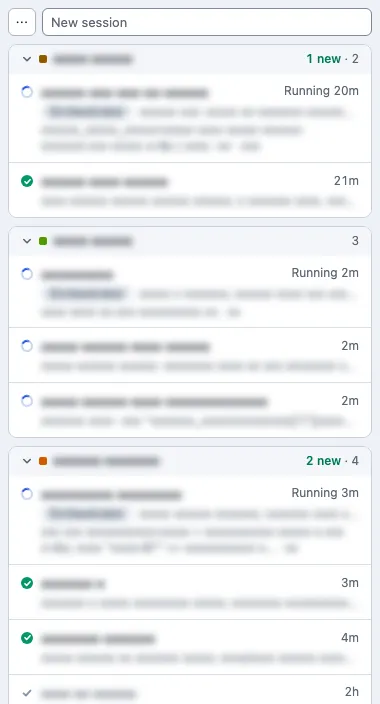
I watch them all from one list on the side of my screen. The ones that need an answer sit at the top in amber, the ones working spin, and the finished ones get a check. One click opens a helper. Another starts a new one, and I can drop a screenshot in with the request.
Next to it is my clipboard history. It shows screenshots as pictures instead of file names, and it hides anything that looks like a password until I ask.
When a big job is split across several helpers, each works in its own copy of the project so they can’t trip over each other. The last step is always the same: check that every piece made it back in. Before that check existed, two finished pieces of work sat forgotten for five weeks.
And nothing gets called done until I’ve seen it work.
One task per session
Every turn re-reads the conversation so far, so a session’s cost grows with its length, not with what it does. In August, 97.7% of every token was that re-read; fresh input and output together were under half a percent. Measured again in September over 405 sessions: a median of 271 turns, and the 53% that passed 300K tokens of context used 89% of the tokens.
So a new task gets a new session. When a long session drifts into a second task, it stops and writes a handoff: what’s done, what’s owed, the branch, and the last verification command with its result. Two failed corrections on the same thing is the other stop sign, since by then the context is mostly failed attempts. A big lookup goes to a subagent, so the file dumps never enter the main conversation.
Handing out work
A small job starts from the New session box at the top of the Sessions panel: a sentence,
a folder, sometimes a pasted screenshot. It runs as a background session (claude --bg),
so it doesn’t take a tab.
A job with independent parts gets a parallel run. Each slice gets a written brief, its own
git worktree and its own branch, and the spawner starts them as background sessions. Two
rules came from one 26-slice run. Worktrees are made one at a time, because 26 checkouts
of a 21,000-file repo at once ran 68 checkout workers on 18 cores. And each brief carries
an Owns: list, because the only files two slices both edited were shared ones nobody
owned.
Before any of that, a change with a real design decision gets a short back-and-forth that ends in a change record: the decision, what’s in and out of scope, and the commands that will prove it worked, in 60 to 90 lines. A change I can describe in one sentence skips all of it.
Watching a dozen at once
The Sessions panel lives in iTerm2’s side panel and redraws every 2.5 seconds. Needs you is on top: every session that stopped to ask, with its question and its options. Then one card per parallel run with its orchestrator first, then Working and Finished. A session whose status line hasn’t changed in 30 minutes turns amber, unless it’s inside a command with a known deadline, like waiting on a deploy. A click opens it in one shared tab that switches sessions, the way Claude Code’s agent view does. In its first day and a half it opened a session 274 times.
The panel doesn’t work any of this out itself. A small Node script reads Claude Code’s own
files (the live registry, the transcripts, each background session’s job file) and the
panel draws what it prints. The same script answers board --waiting in a terminal, so the
two can’t disagree.
The clipboard
iTerm2’s paste history showed four pasted screenshots as four identical /var/folders/…
paths, and a copied API key in plain text. The Clipboard panel replaced it: pictures as
thumbnails, files by name, anything that looks like a key hidden until I click Show, and
nothing a password manager marks private is ever kept. Clicking an item pastes it into the
tab in front, and a picture pastes as the path of its saved copy, which is how a session
gets a screenshot. A notes box on top holds whatever I need in front of me for the day.
Checking the work
Nothing is “done”, “fixed” or “passing” without the output behind it: the project’s real gates (the same commands CI runs), a query against the data, or the page itself. The testing browser runs headless, because a window that pops up takes my screen and breaks the test the moment I touch it. When a site needs me to log in, a separate window opens for that one step, and the headless browser carries on signed in.
Closing a run
A run isn’t finished when every slice says done. It’s finished when every slice’s branch is merged, the gates pass on the integration branch, and the slice sessions and worktrees are gone. That check exists because two pieces of finished, tested work once sat unmerged for five weeks. Every task also ends with the lines added and removed, so growth shows up where I’ll see it.
The rest of the kit
Counted from the last 30 days of transcripts, so this is what the sessions ran, not what I typed:
- A read-only connection to the ERP’s database, the most-used tool here at 20,016 calls. It’s how “verify before you assert” actually gets done.
- A headless test browser signed in as its own test user, so my logins never pass through a session: 9,482 browser calls. The skill that drives it to test a page was called 238 times, more than any other.
- A real iPhone Safari in the Xcode Simulator, because desktop WebKit let a “search needs two taps” bug through on 2026-10-09.
- A page fetcher in headless Chrome for vendor docs that hang for anything that isn’t a browser: 130 runs.
- A second browser with my everyday logins. Some sites are signed in only in Zen, so Claude gets a headless copy of one Zen container’s cookies (never a bank’s or a payment site’s), or works in my own open Zen while I’ve turned that on: 931 calls in its first nine days.
- An account switcher for the Claude accounts I sign in with: a profile per account with its own login, the same skills and settings in each, and every account’s usage in one list.
- A code index for “what calls this” and “what breaks if I change it”: 593 calls, in place of rounds of greps.
- Notes between sessions on the same repo, for a file I’m mid-rewrite on or a bug that crosses areas: 117 sent, on top of the commits and pushes that announce themselves.
- Small hooks: the Dock icon bounces and the tab turns blue when a session finishes or asks something, and each tab is named after its prompt.
The panels, the spawner, the account switcher and the Zen browser server are in
code/, MIT licensed:
iterm-panels, fleet-scripts, account-switcher and zen-browser.
What I learned
- Starting a session is nearly free; keeping one alive is what costs. A 67K-token start is about 0.1% of a median session's re-reads, and 97.7% of every token spent in August was the conversation being re-read on each turn (727 transcripts, 30 days).
- A 26-slice run that made all its worktrees at the same moment ran 68 checkout workers on 18 cores, about ten minutes a checkout, and 9 sessions died mid-checkout while the orchestrator counted 26 running. Worktrees are now made one at a time, and a slice only counts as started once its session registers.
- In that same run only 8 of 199 files were edited by two sessions, and all 8 were shared files nobody owned. Each brief now names the files its session owns, and the others ask the owner instead of editing.
Parameters
Request
curl "https://dylansg.com/api/ work/ agent-fleet/ daily-workflow? fields=learned"
Response200 OK · 868 B
{
  "learned": [
    "Starting a session is nearly free; keeping one alive is what costs. A 67K-token start is about 0.1% of a median session's re-reads, and 97.7% of every token spent in August was the conversation being re-read on each turn (727 transcripts, 30 days).",
    "A 26-slice run that made all its worktrees at the same moment ran 68 checkout workers on 18 cores, about ten minutes a checkout, and 9 sessions died mid-checkout while the orchestrator counted 26 running. Worktrees are now made one at a time, and a slice only counts as started once its session registers.",
    "In that same run only 8 of 199 files were edited by two sessions, and all 8 were shared files nobody owned. Each brief now names the files its session owns, and the others ask the owner instead of editing."
  ],
  "page": "https://dylansg.com/work/agent-fleet/daily-workflow"
}
Live: this is the answer from this site’s API, not a mock. Send re-runs the request with your parameters; if the answer names a page, it opens.